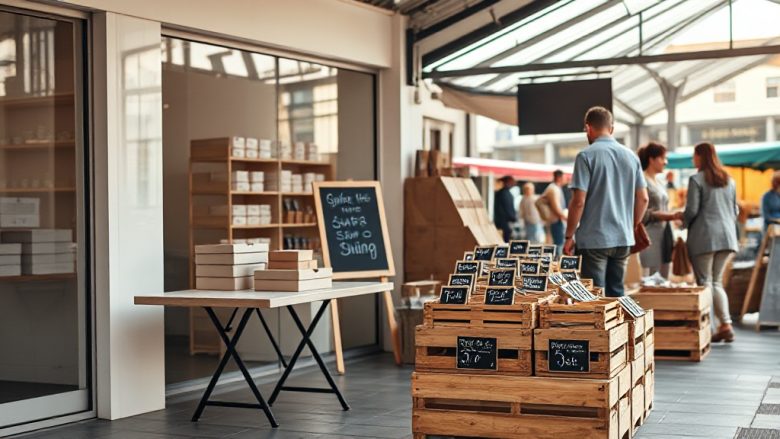
Most online sellers think about a pop-up backwards. They ask how much stock they can sell in three days, then panic when the numbers look thin. Flip the question. A short-term physical space is a research tool with a rent bill attached. You are buying something you cannot get from a dashboard: the sound a product makes when someone picks it up, the moment a shopper puts it down again, the questions people ask before they decide. Expert advice on pop up shops tends to circle the same point, and it is worth stating plainly at the start: the sales figure matters, but the observations matter more.
If you have only ever sold through a marketplace listing or your own storefront, a weekend unit in a market hall or a vacant high street space is the cheapest way to find out whether your product has a physical life. You will spend a few hundred pounds on rent, some time on setup, and a weekend of your own energy. In return you get real footfall, real objections, and a clear signal about whether a permanent shop is a fantasy or a next step. Everything below is written for that first attempt.
Choosing a Location That Actually Tests Something
The temptation is to pick the busiest pitch you can afford. Resist that for a first run. Busy locations are expensive, and high rent pushes you towards selling anything to anyone, which muddies the experiment. What you want is a location whose footfall resembles the customers you already have online.
Start by describing your existing buyer in practical terms. Are they commuting professionals who pass a station between eight and nine, or parents pushing buggies on a Saturday morning, or students with time and small budgets? Then look for a pitch that already hosts that traffic. A covered market with a steady lunchtime crowd will tell you more about a food product than a craft fair full of browsers. A weekend antiques market will tell you more about a vintage homeware line than a shopping centre unit.
Ask the operator specific questions before you sign anything. How many people pass the pitch on a typical Saturday? What is the split between weekday and weekend trade? Is there storage on site, or do you carry everything in and out each day? Can you leave a rail or shelving overnight, or does it all have to fit in a car boot? These details decide whether a location is workable, not just whether it is fashionable.
Also think about what surrounds you. Being next to a coffee stall buys you dwell time, because people linger with a cup and browse. Being tucked behind a loud produce seller can bury you. Walk the site at the same time of day you would trade, and watch where people actually stop rather than where they walk fastest.
One more thing: check what the pitch allows. Some markets restrict signage, some ban music, some require you to sell only certain categories. A location that fights your product is not a fair test, so read the terms before you commit.
Stock and Pricing for a Short Run
A pop-up is not a small shop. It is a compressed shop, and the stock plan should reflect that. The biggest mistake is bringing your full catalogue because you cannot decide what to leave out. A crowded table confuses people and slows every sale. Bring a tight range and let the space do some of the selling.
Work out a rough target before you pack. If you expect a hundred visitors over a weekend and a conversion rate of one in five, that is twenty sales. Multiply by your average order value and you have a rough revenue ceiling. Then decide how much stock you need to cover that, plus a buffer for the product that unexpectedly takes off. Running out of your best seller on Saturday afternoon is a wasted Sunday.
Pricing needs a short-run logic of its own. Your online price already includes shipping, so a physical price can often sit slightly lower and still feel fair. But do not discount just because you are in a tent. Discounting trains people to wait for the next markdown and undermines the product. Instead, use bundles: buy two of the small size and save a little, or pair a bestseller with a slower item. Bundles move stock without cheapening the brand.
Think about what people can carry. If your product is bulky, offer to hold purchases behind the counter while shoppers finish browsing, or arrange a simple delivery option for larger items. A shopper who cannot carry something will often walk away, and that lost sale has nothing to do with the product.
Finally, price your display. A single item on a bare table looks like a sample. The same item on a small riser with a clear handwritten sign looks like a considered purchase. You do not need expensive fittings. Clean crates, a length of fabric, and a few well-placed cards will do more than a shelf full of clutter.
Staffing, Footfall and the Human Side of a Short Run
Two people is usually the right number for a first pop-up. One can talk to customers while the other restocks, handles payments, and watches the pitch. Alone, you cannot do all of that well, and a queue of two people can feel like a crowd to someone deciding whether to approach.
If you bring help, brief them properly. Give them three sentences about what the product is, who it suits, and what the most common question is likely to be. Then let them listen to real customers rather than recite a script. The best market staff are curious, not pushy. They ask what brought someone over, and they remember the answer.
Footfall is not the same as interest. Watch the difference. Some pitches have heavy passing traffic but almost no stopping, often because the layout funnels people past rather than into the space. Others have lighter traffic but a high stop rate, because the display invites a look. If you are getting plenty of glances and no conversations, change the display before you blame the location.
Simple things shift behaviour. Standing in front of the table rather than behind it makes you approachable. A small free sample or a bowl of something to touch lowers the barrier. A clearly marked price removes the awkward question that stops people engaging at all. None of this is clever, but it is the difference between a stall people walk past and one they stop at.
Keep a rough tally through the day. Not a full spreadsheet, just marks for visitors, conversations, and sales. You will forget the detail by Monday, and the pattern across two days is often more revealing than the total.
What to Measure Once the Weekend Is Over
Here is where the experiment pays off, and where most sellers waste the opportunity. Do not just count the money. Sit down within a day or two, while the memories are fresh, and work through what actually happened.
Start with the numbers you can trust. Total revenue, number of transactions, and average transaction value give you a baseline you can compare against your online figures. Then add the softer data: how many people stopped, how many asked a question, how many picked something up and put it back. A high pick-up rate with a low purchase rate usually points to price or packaging rather than the product itself.
Listen again to the questions you were asked. If ten people asked whether an item came in a different size, that is a product gap, not a sales problem. If several asked whether you had a website, that is a signal about how people want to buy from you afterwards. Write the questions down verbatim if you can. They are free market research.
Compare your expectations with the reality. Did the location deliver the footfall the operator promised? Did your best online seller perform as well in person, or did a quiet product become the star? Did you sell out of anything, and did you have too much of something else? Each answer tells you whether a longer run, a different pitch, or a permanent space deserves your money next.
Then make one decision, not five. Perhaps you will book the same pitch for a full week to test weekday trade. Perhaps you will drop two products and double down on one. Perhaps you will conclude that physical retail is not for you, which is a perfectly good result from a cheap experiment. The point of a pop-up is not to prove you can run a shop. It is to find out, with real customers and real money, what your product does when someone can finally hold it.
Treat the weekend as a test, keep the setup simple, and let the evidence guide the next move. That is the most useful expert advice on pop up shops you will get, and it costs far less than learning the same lesson from a twelve-month lease.